Product Overview
Most 12V lithium upgrades stumble on the accessories rather than the cells: the old charger keeps boiling the pack, or nobody can tell how much capacity is actually left. This kit closes both gaps in one order. You get the battery, a charger built for lithium profiles, and a touch monitor with the sensors and harnesses needed to wire it in — so a bare 12V deep cycle battery becomes a system you can read at a glance.
It suits the places a 12V block usually lives: a caravan battery box, the trolling motor on a fishing boat, an off-grid cabin's solar bank, or a standby circuit for alarms and gates. Anyone stepping up from lead-acid gets the familiar shape and terminal layout, then notices the difference on the first lift.
If you are also working on a golf cart or a home storage bank, the same range runs through 36V and 48V cart packs and 51.2V storage units, so the metering habits you learn here carry over.
What's in the Box
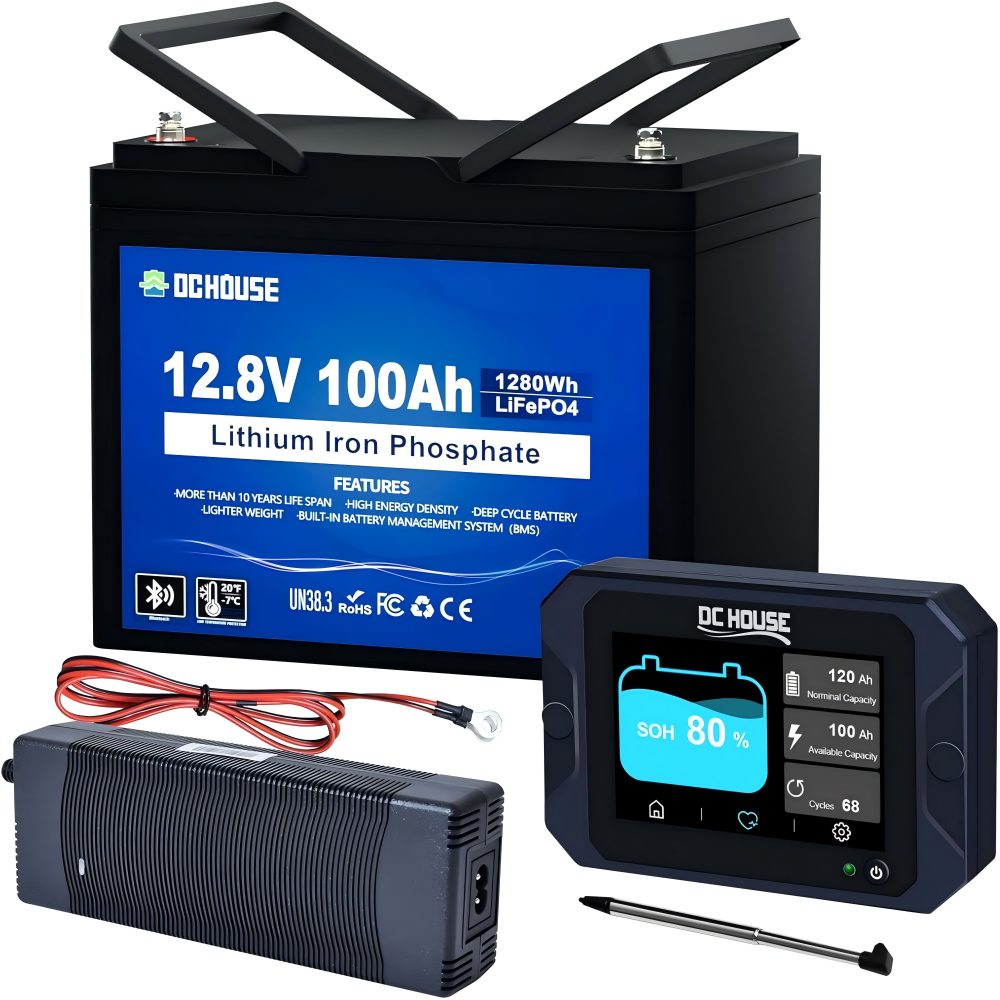
- The pack — a 12V LiFePO4 battery in a black rectangular case with a blue front label, top carry handles and screw terminals on top.
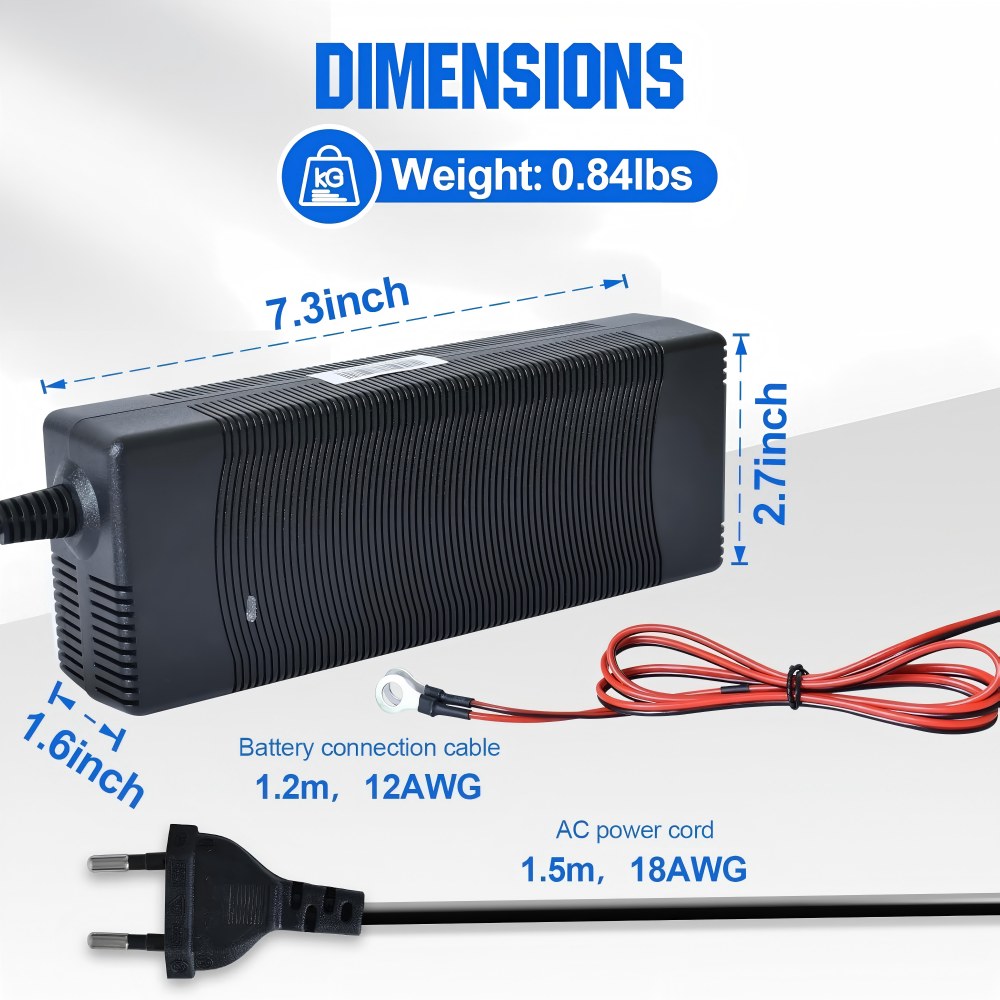
- 10A charger — a LiFePO4 battery charger in a ribbed housing, with an AC cord and a battery lead fitted with ring terminals.
- Touch monitor — a 3.5-inch colour screen in its own housing, with a stylus for the touch panel.
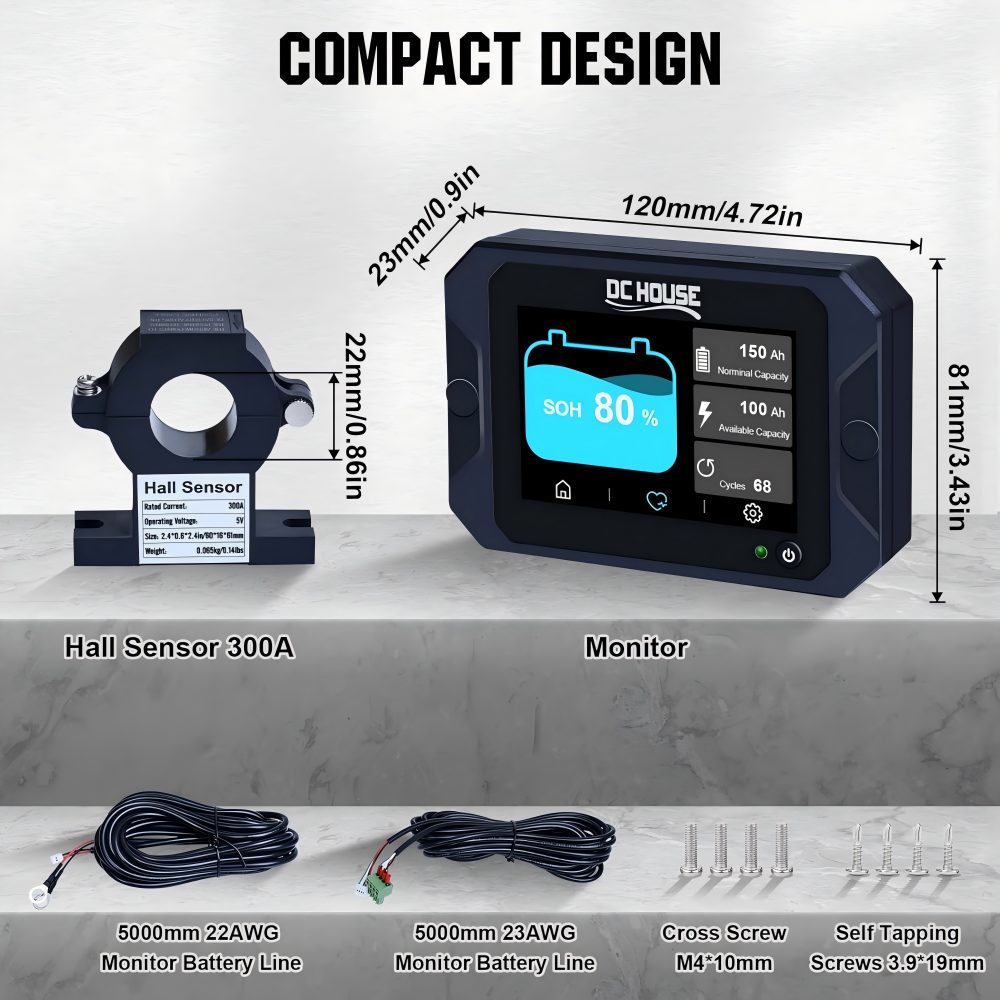
- Sensing hardware — two hall sensors, the monitor battery lines and ring terminals needed to connect the display to the pack.
- Fixing pack — cross screws and self-tapping screws for the monitor mount, plus a cable tie to tidy the cable run.
- Before the first trip — charge the pack to full so the monitor starts from a proper full reference.
300A Monitor & Alerts
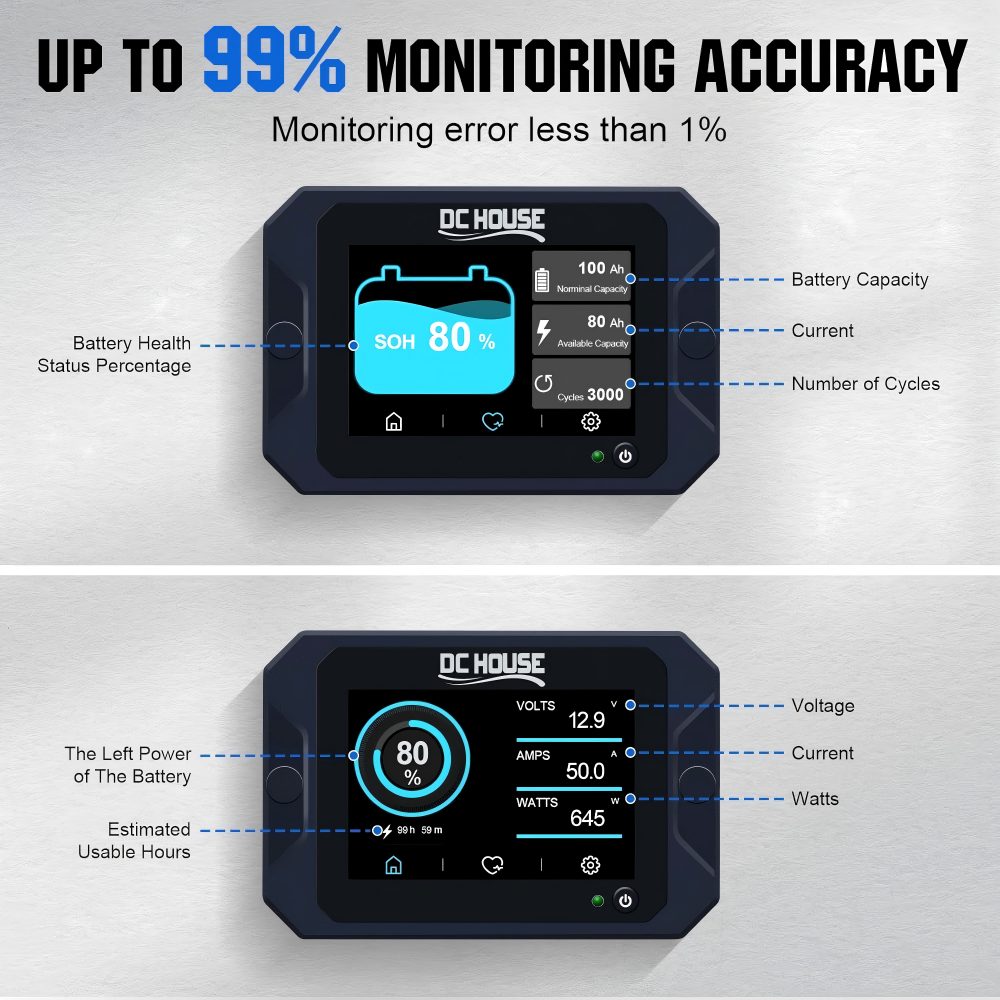
The display is the part most buyers underestimate. It is a 3.5-inch colour touch screen rated to 300A, and it turns the pack from a black box into something you can actually read: voltage, current in amps, watts, remaining capacity in Ah and the cycle count all sit on one screen, with a health figure showing how much of this deep cycle lithium battery's original capacity is still there. The screen also estimates usable hours at the present draw, which is the number that decides whether you run the fridge overnight or switch it off before bed. Alarms are the other half of the job. The monitor beeps when voltage, current or temperature swing too high or too low, so a hot charger, a loose connection or a load that is drawing too much shows up loudly rather than silently draining the pack. Because the unit covers 12V, 24V, 36V and 48V systems, it stays useful if you later move up to a bigger bank.
Charging the Pack
- Check the resting voltage on the monitor first — a pack at rest should sit close to its 12.8V nominal figure.
- Clip the charger lead to the posts: red to positive, black to negative.
- Plug the LiFePO4 battery charger into a mains outlet and let it run at up to 10A.
- Allow about 10 hours from empty; the maker notes the real figure can run slightly longer.
- Leave it to finish on its own — the charger stops automatically at full charge and protects against over-voltage, over-current, short circuit and overheating throughout.
- If the BMS has already tripped and the pack reads at 0V, the charger's 0V mode can bring it back to life.
- Watch the current taper on the monitor as a deep cycle lithium battery approaches full; the last stretch is slow by design and is not a fault.
Power, Weight & Protection
- Liftable by one person — the 100Ah LiFePO4 battery weighs 11.5 kg, roughly a third of the lead-acid block it replaces, so getting it into a locker or a battery box is a solo job rather than a two-person one.
- Years, not seasons — the pack is rated at more than 8,000 deep cycles, well beyond the working life of the lead-acid deep cycle batteries it displaces.
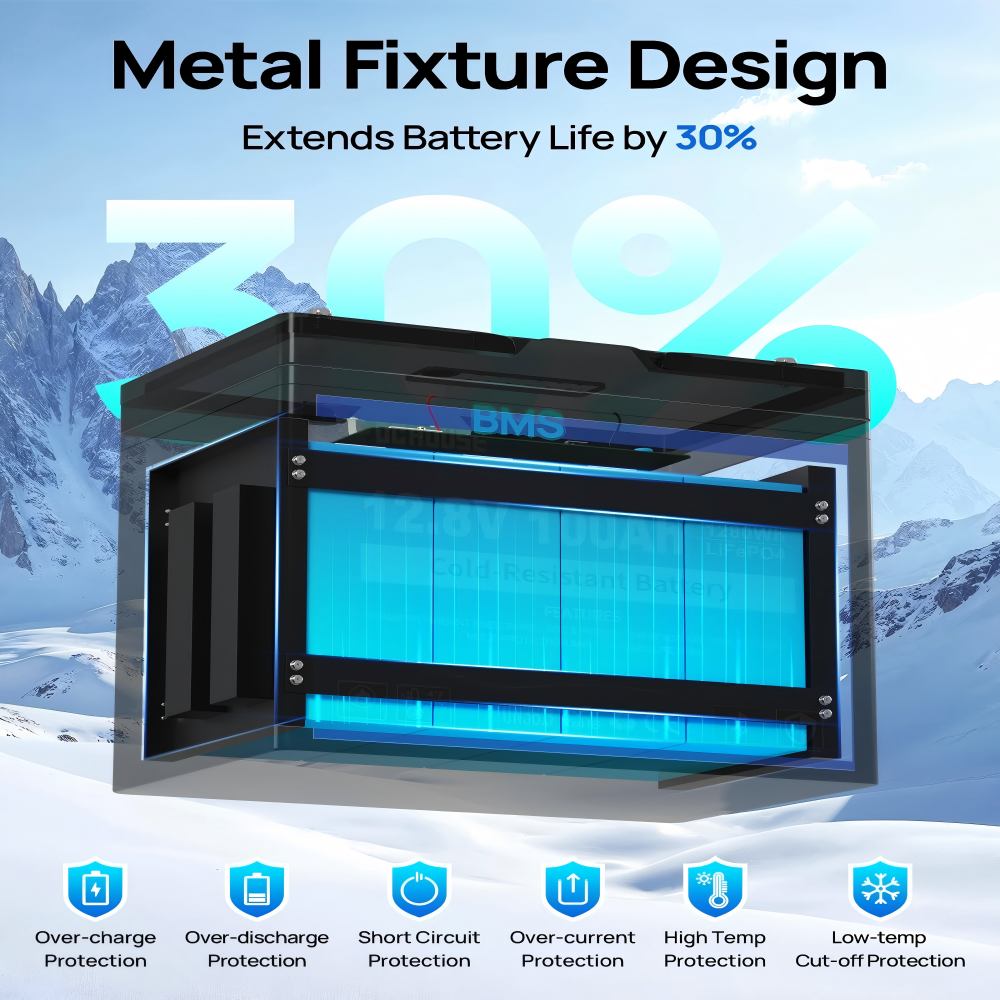
- A BMS that acts, not just watches — it protects against overcharge, over-discharge, over-current and short circuit, and shuts the pack down when something is wrong. Voltage can then read below 1V, which is the protection working rather than a dead battery.
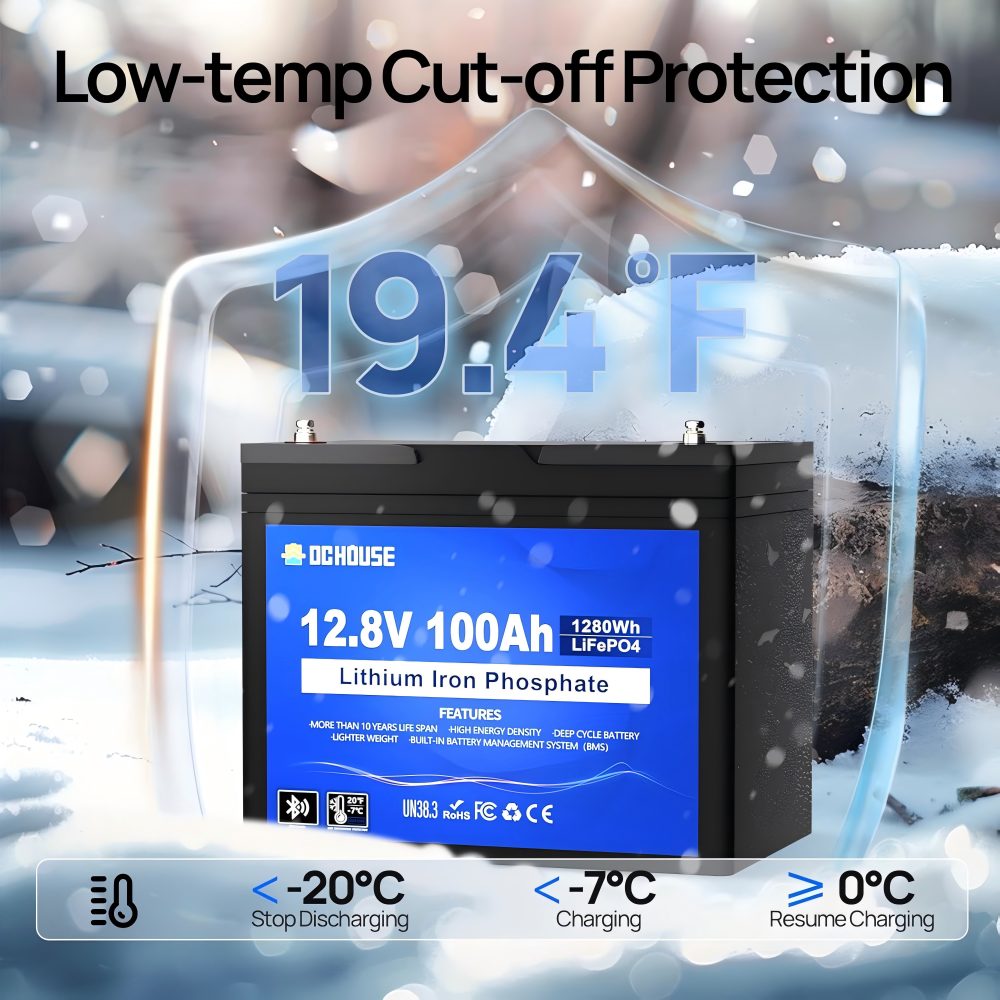
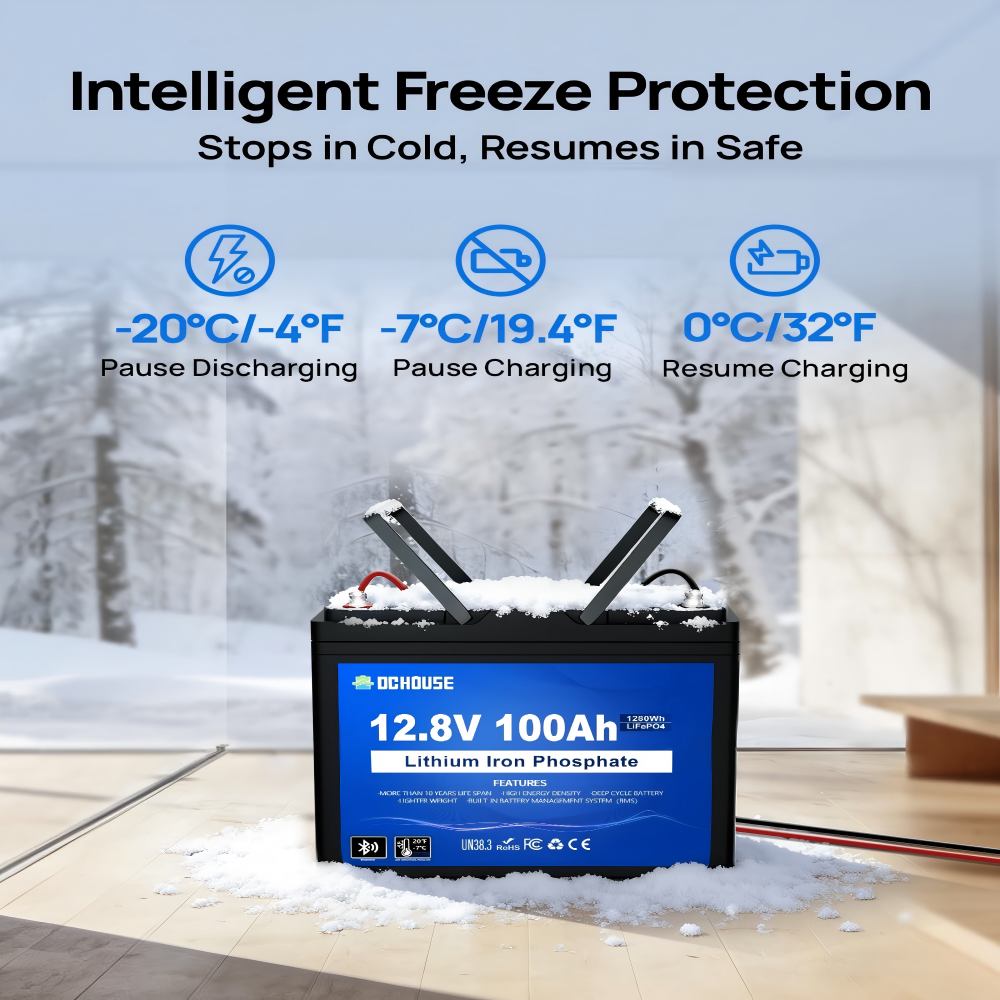
- Cold-weather cut-off — discharge stops at about −20 °C, and charging is blocked once the pack drops below freezing and resumes at 0 °C and above.
- Sized for real 12V loads — this 12V LiFePO4 battery is aimed at fridges, lights, pumps, fish finders and trolling motors rather than engine cranking.
- No maintenance routine — no water levels to check, no equalising charges, no acid residue in the locker.
- Caravans and motorhomes are the classic case: an RV deep cycle battery carrying lights, a water pump and a compressor fridge through the night, then taking a charge from mains or solar the next morning. On the water, the same pack works as a 12V deep cycle marine battery for trolling motors, fish finders, livewell pumps and navigation electronics, and because the case is sealed it can live in a locker that would have eaten a flooded lead-acid block. Ice anglers keep a flasher and a heater running on one; off-grid cabins pair it with a solar panel for lights and a small inverter; alarm and gate systems use it as standby power; campers run lights, phones and a fridge from it. The 12V accessory circuits on a golf cart or a utility vehicle are within reach too. What these share is a load that runs for hours at a moderate draw rather than a burst of cranking current. That is the duty this pack is built for.
Installation & Wiring Order
- Start with the compartment: measure the space and the old block, and note which side the terminals sit on so your cables still reach. If you are replacing an RV deep cycle battery, check the lead lengths before you commit.
- Photograph the existing wiring before you touch it — it saves an hour on reassembly.
- Isolate the system, then take off the negative lead first and the positive second.
- Lift the old block out and set the new pack in place. It goes where the lead-acid deep cycle batteries sat, handles up, terminals on the same side, strapped down so it cannot slide.
- Reconnect positive first, negative second, and check both terminal screws are snug without over-tightening them.
- Mount the monitor where you can read it from the helm or the driver's seat, clip a hall sensor around the cable you want to measure and run the sensor cable back to the display.
- Switch the monitor on and check voltage and current before any load is connected — a quick sanity check beats a blown fuse later.
- Charge to full, then take a short shakedown run before committing to a long trip.
Specifications
| Configuration | 12V 100Ah LiFePO4 battery with the 10A charger and 300A touch monitor |
| Chemistry | LiFePO4 (lithium iron phosphate) |
| Nominal voltage | 12.8 V |
| Stored energy | 1280 Wh |
| Energy density | 57 Wh/lb |
| Terminals | Screw terminals on top of the case |
| Charger output | Up to 10 A |
| Monitor | 3.5-inch colour touch screen, 300 A rated |
| Monitor inputs | Two hall sensors |
| Monitor accuracy | Up to 99%, error under 1% |
| Monitor use | 12 V / 24 V / 36 V / 48 V systems |
| Replaces | Lead-acid deep cycle batteries in the same 12 V role |
| Markings on the pack | UN38.3, RoHS, FC, CE |
Care & Storage
Treat a 12V deep cycle battery well and it will outlast the vehicle it lives in. Recharge it after each trip rather than letting it sit flat, and use the monitor's state-of-charge reading as the trigger — when it drops low, put the pack on charge.
For storage, leave it part-charged rather than full or empty, keep it in a dry, ventilated spot out of direct sun, and top it up every couple of months. The monitor makes that easy: switch it on, read the capacity, decide.
Keep the terminals clean and dry, and keep the monitor and charger out of standing water and spray. The battery case is sealed; the electronics that hang off it are not built to be soaked.
Cold weather needs a little planning. Charging is blocked while the pack is below freezing, so warm it up or wait for a thaw before plugging in — the cut-off is there to protect the cells, not to inconvenience you.
If the 12V deep cycle marine battery in your boat is laid up for the winter, do the same: part charge, dry locker, a top-up before launch. Check the health figure on the monitor once a season; it is the earliest warning you will get that capacity is drifting.
Ordering & Delivery
- Dispatch — stock orders leave in 3–7 days.
- Custom builds — around 35 days.
- Shipping — stock is held locally, with 3–7 days for shipping.
- Warranty — 5-year warranty.
- Fit check — send the compartment measurements and terminal positions with your order and our team will check the 12V LiFePO4 battery against them.
- Load check — tell us what you plan to run, whether that is a trolling motor, a fridge or an inverter, so we can flag anything a 100Ah pack will not carry for the hours you need.
About Our Company
Xinyubattery is the brand of Shenzhenshi Xinyu Newenergy Technology Co.,LTD, a Shenzhen-based company founded in 2016 and working in green power solutions for more than ten years. Through a vetted network of production partners, we bring a broad range of power products together in one place and consolidate each order for you. Products are checked before dispatch, packed for export and shipped from local stock, and our team stays available for technical advice, fitting questions and after-sales help.
FAQ
Can this 12V 100Ah LiFePO4 battery live inside a camper or a boat cabin?
Yes. The pack is sealed and does not vent acid fumes or need watering, so it can sit in a living space where a flooded lead-acid block could not. Mount it upright in a dry, ventilated spot, keep the terminals covered, and place the monitor and charger where they will not get splashed. It is a deep-cycle pack for powering loads — lights, fridges, pumps, electronics — rather than a cranking battery for an engine.
If I move up to a bigger deep cycle lithium battery later, can I keep the monitor?
Yes. The monitor covers 12V, 24V, 36V and 48V systems and reads through its own hall sensors, so it can be re-mounted on a larger pack or a different bank. The 10A charger is a 12V unit and stays with the pack it was matched to.
How does this kit differ from the Bluetooth 12V version?
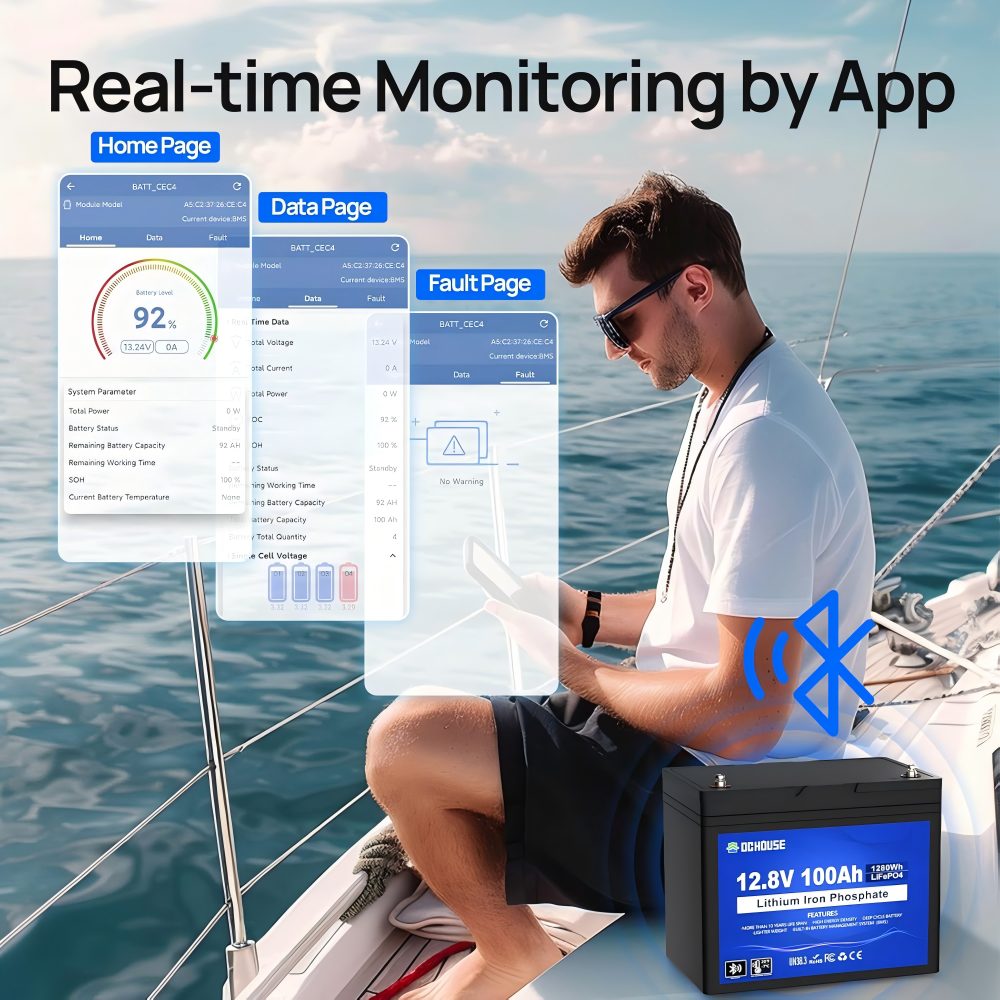
Both are 100Ah packs; the difference is how you read them. This 12V deep cycle battery kit ships with a standalone 3.5-inch touch monitor that shows voltage, current, watts, remaining capacity and health on a screen you mount in the vehicle, with no phone involved. If you would rather check everything from an app, the Bluetooth version is the one to look at.
Do I have to use the charger that comes in the box?
No, but if you use your own, choose a LiFePO4 battery charger with a lithium charging profile and a current rating suited to a 100Ah pack. The supplied 10A unit is already matched: it stops automatically at full charge and can revive a pack that the BMS has shut down to 0V.
Will it keep an RV fridge and lights running overnight?
It depends on the draw rather than the label. A compressor fridge, a few LED lights and a phone charger are comfortably within what an RV deep cycle battery of this size holds for a night; add an inverter, a coffee machine or a heater and the hours drop quickly. Share the wattage and how long each item runs and we will give you a realistic runtime instead of a guess.
Can I charge a 12V deep cycle marine battery from solar or from the boat's alternator?
Yes, provided the charging source is set up for lithium. Solar needs a controller with a LiFePO4 profile, and an alternator needs a DC-DC charger or a regulator that will not hold the pack at a lead-acid float voltage. The included 10A charger is for mains charging at the dock or in the garage.