Product Overview
Lithium iron phosphate has changed what people expect from a 12V deep cycle battery. There are no lead plates to sulphate, no water to top up and no slow fade after a few hard discharges. The cells hold their voltage under load, so the fridge, the pump or the trolling motor behaves the same at the end of a long day as it did at the start.
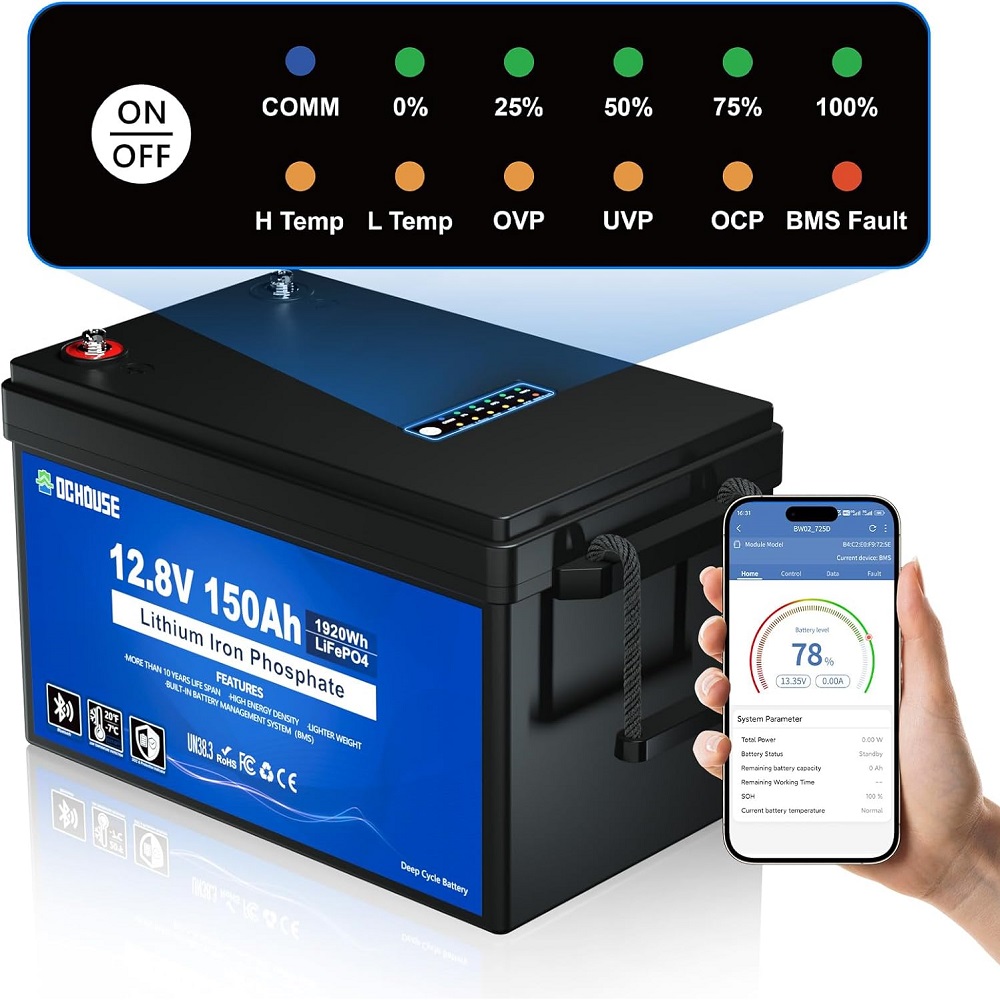
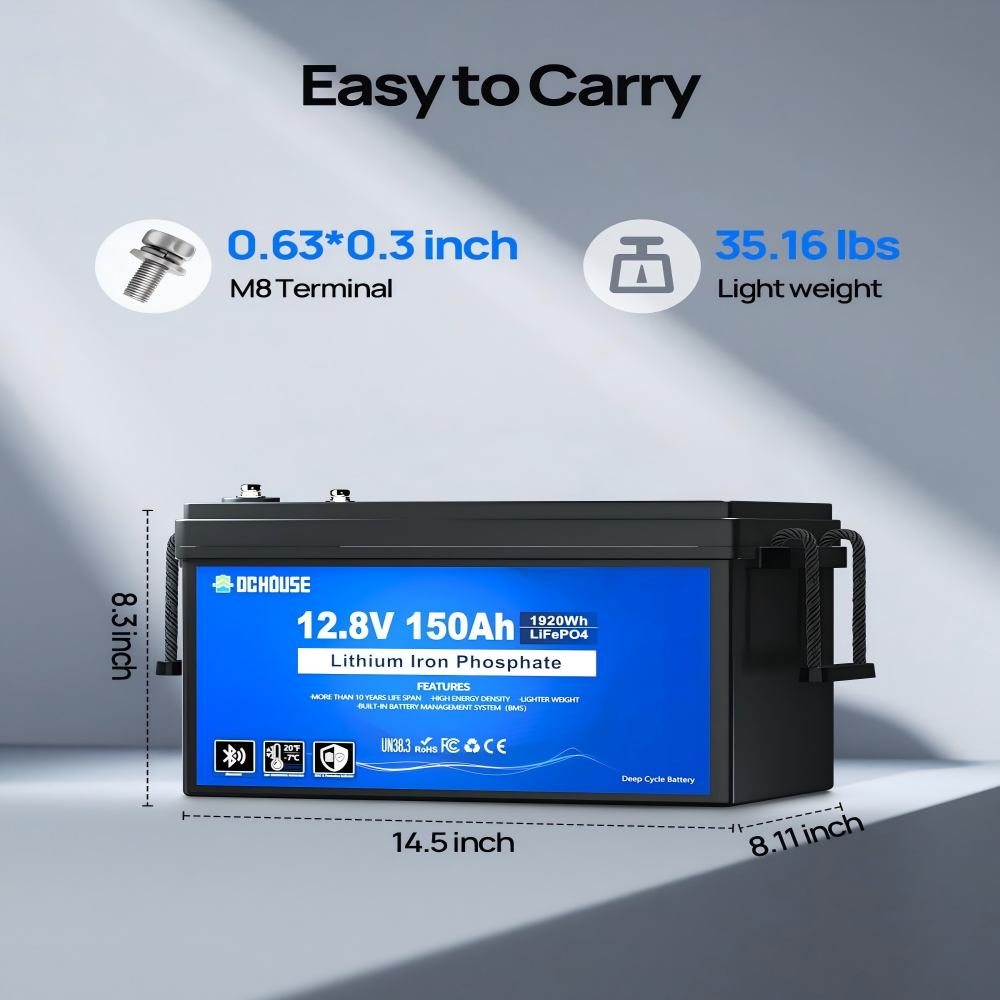
A 12V LiFePO4 battery is also easier to live with in a tight locker. This one sits in a black case with a printed blue label, top-mounted threaded terminals and rope carry handles, so it lifts out and goes back without a second pair of hands.
At 150Ah it lands in the middle of the 12V range: more reserve than the 100Ah units many owners start with, and less weight to wrestle into a battery tray than a 200Ah block.
Day to day there is very little to do. Charge it, glance at the light panel before you set off, and open the app when you want the detail. Nothing needs topping up between trips and there is no routine terminal maintenance to keep on top of.
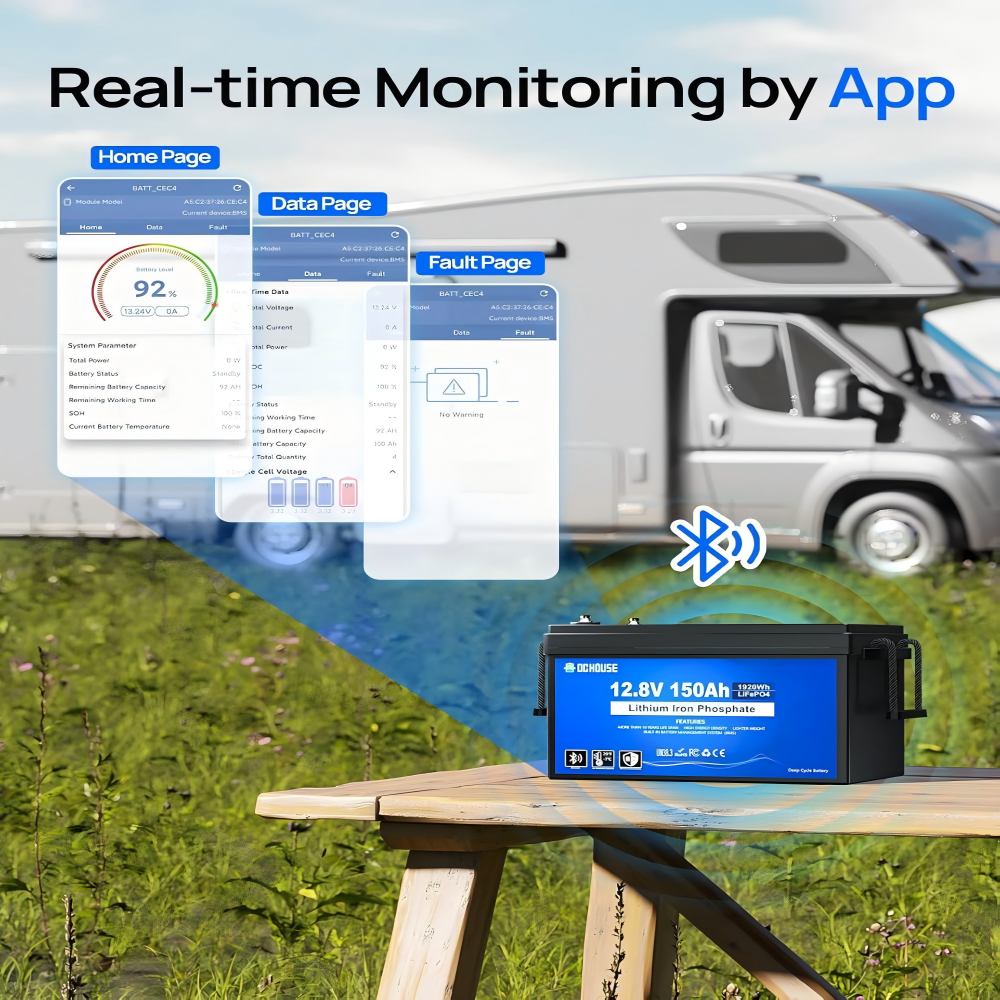
Three systems look after it while you are away: the state-of-charge panel built into the case, a Bluetooth app that reports down to individual cells, and a low-temperature cut-off that stops charging before cold weather can damage the cells.
State-of-Charge Panel
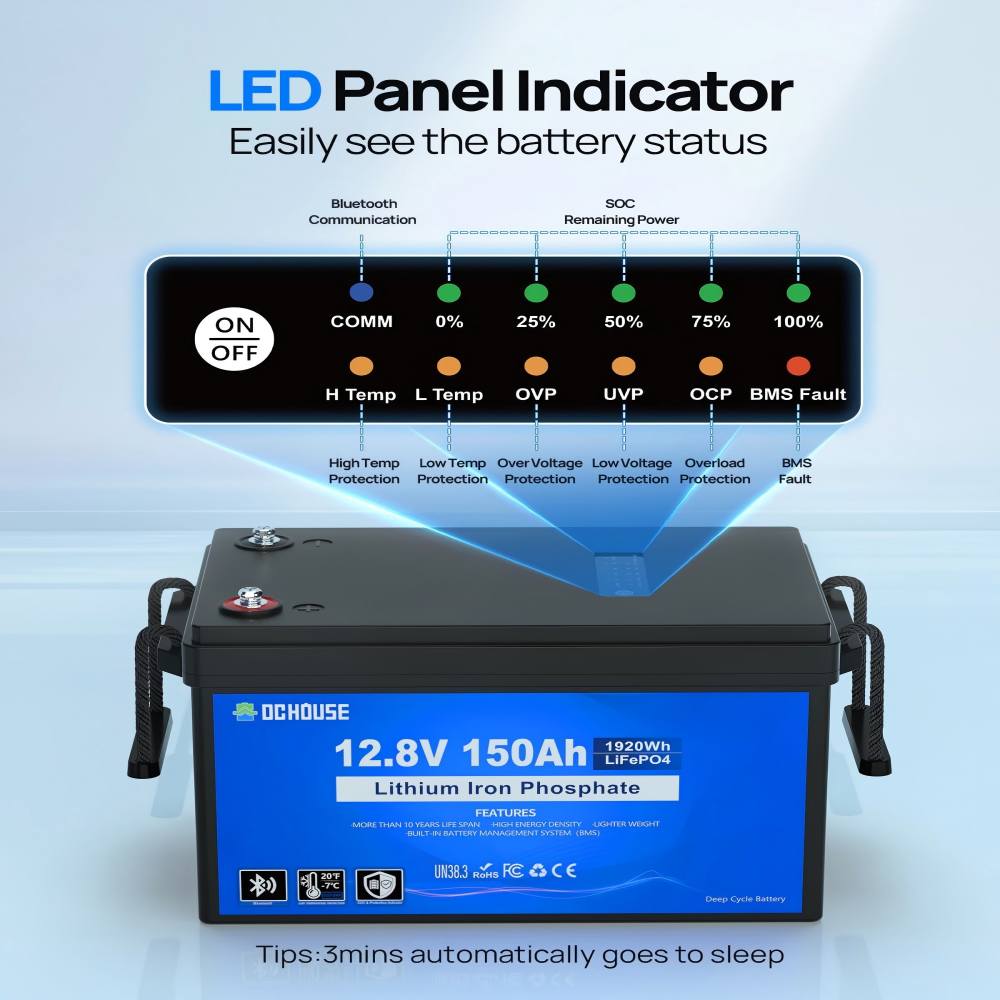
The quickest way to read this lithium deep cycle battery is the light strip set into the top of the case. Five bands run from 0 to 100 per cent, so one glance tells you whether there is a full evening in it or whether it needs to go on charge before you leave. Separate lights show charging in progress, and there are warnings for over-voltage, under-voltage and over-current.
Nothing here needs a phone. The panel reads with the battery switched off, in a dim locker or on a frosty morning — which is the point, because the moment you most want to know the state of charge is usually the moment you are already running late.
The panel is deliberately simple: it tells you which band you are in, not the exact amp-hours left. For that, and for anything that looks wrong, the app goes further.
Anyone stepping up from a 12 volt deep cycle battery of the lead-acid kind will notice how little the reading moves under load. A lead-acid gauge sags the moment a pump or an inverter starts; this one holds steady.
Bluetooth App Monitoring
| Feature | Detail |
|---|
| Bluetooth version | 5.0 |
| Signal range | 5–10 m, about the length of a caravan or a boat cabin |
| App | DCHOUSE |
| Pairing | Paired from the app on your phone, then reopened whenever you want a reading |
| Data reported | State of charge, voltage and current |
| Detail level | Individual cell monitoring |
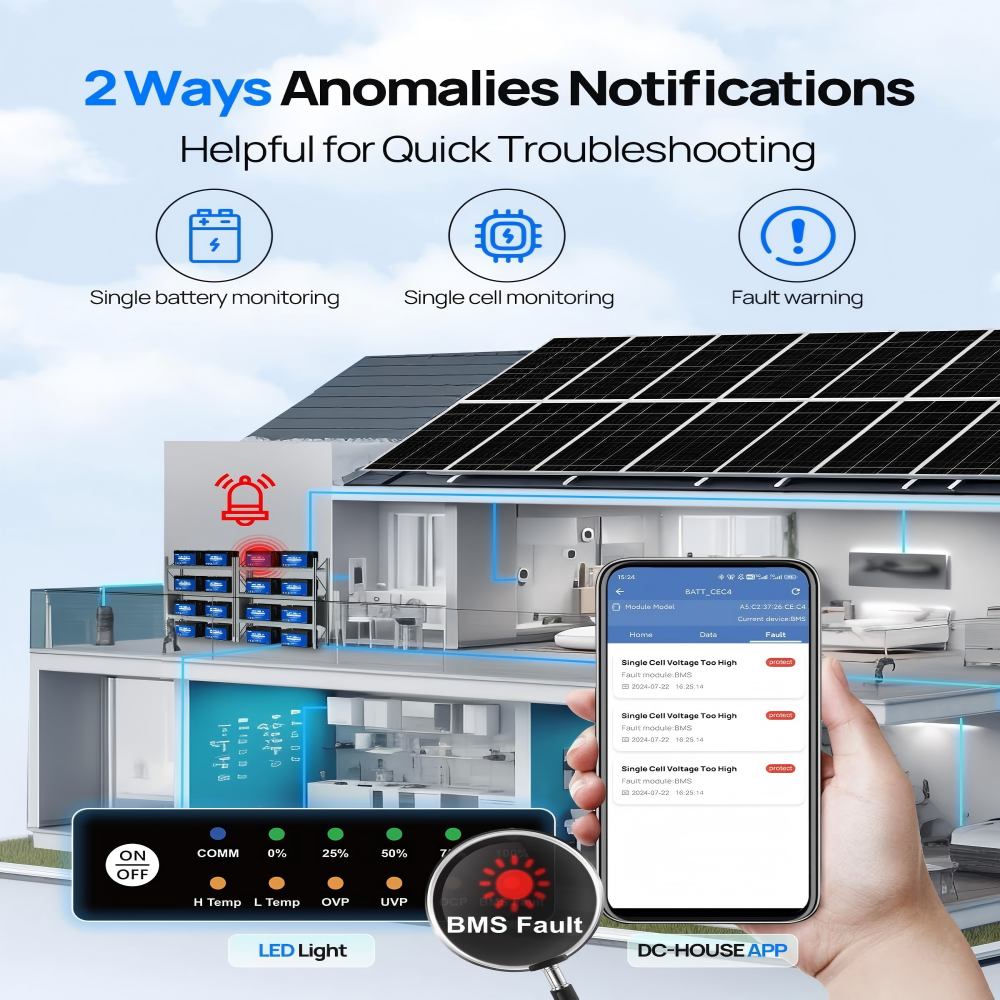
| Fault reporting | Dedicated fault page inside the app |
| Works alongside | The LED status panel on the case |
| Load check | Switch appliances on one at a time and watch the current figure change, so you can see what a fridge, a pump or a small inverter actually asks for |
| Charge check | Confirm the charger is pushing current in rather than trusting a light on the front of the unit |
| Cell balance | Compare the strongest and weakest cell so a drifting cell shows up on a quiet evening, not on the morning you leave |
| Trip check | Open it on the day you set off to see the bank is where you expect, then again at camp to see what the evening has drawn down |
| Phone check | Confirm the DCHOUSE app runs on your handset and operating system before you rely on it away from home |
Cold-Weather & BMS Protection
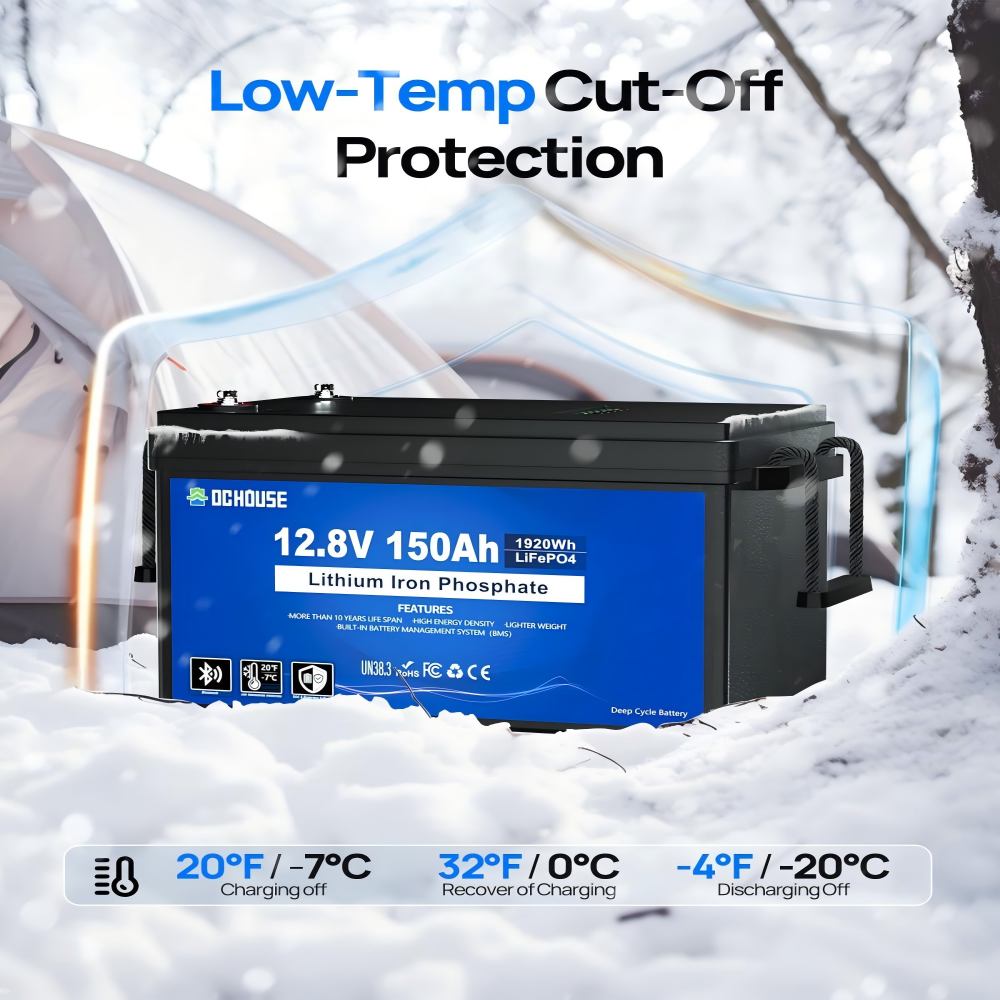
- Charging stops below 32°F. A temperature sensor inside the battery reports to the BMS, which blocks charge current before cold conditions can plate lithium onto the anode and cost you capacity. You do not set anything; the protection is already there.
- Discharge continues into deep cold, down to -7.6°F. Lights and electronics keep working well below freezing; it is charging that gets restricted first.
- Recovery is automatic. Once the battery warms, the cut-off releases on its own and charging resumes. There is no reset button and no code to clear.
- The warnings are visible. L Temp and H Temp flags light on the case panel, and the same conditions appear in the app with a fault page that tells you which one has triggered.
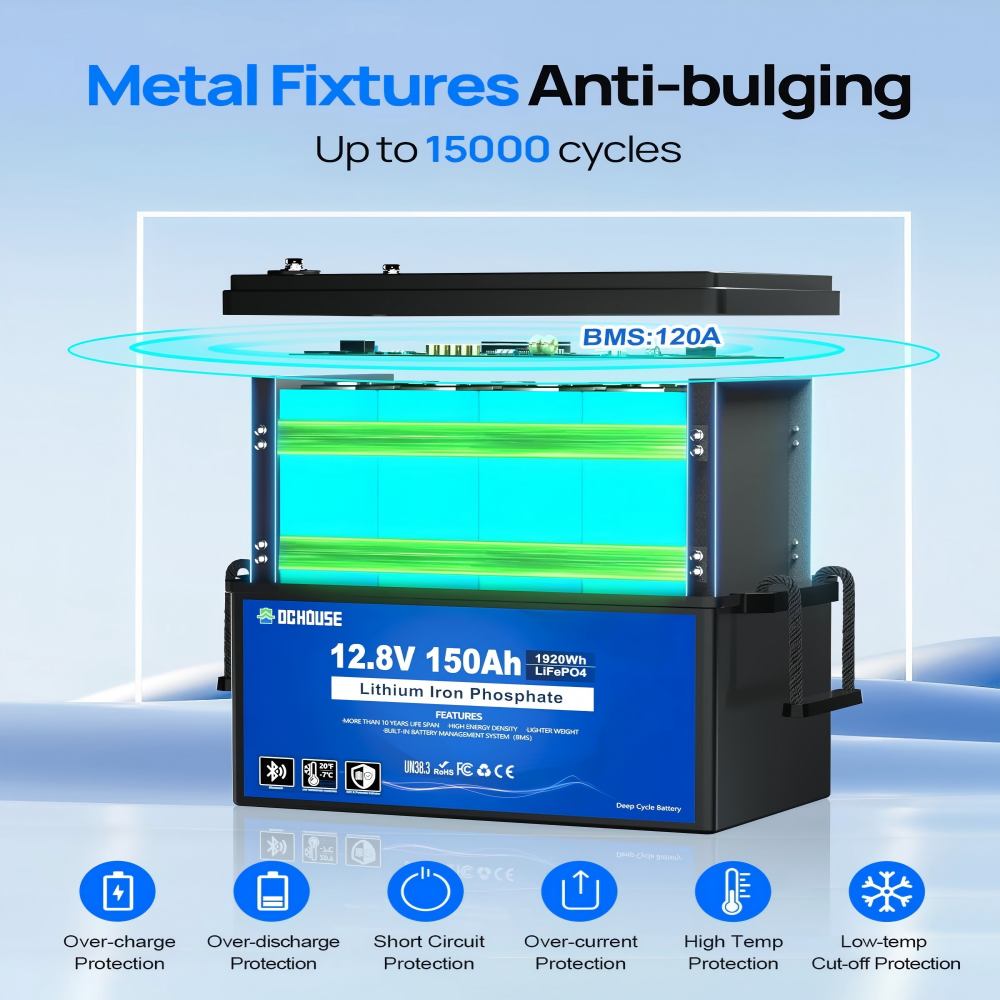
- Built in, not bolted on. Protection sits inside the 12V LiFePO4 battery alongside cell monitoring, so it works whether or not a phone is nearby.
- Over-current and short-circuit protection run through the same system, which matters on a trolling motor that pulls hard from a standing start.
- Pair it with the right charger. Use a deep cycle battery charger built for lithium. A lead-acid unit can hold the battery at a voltage its BMS does not want.
- What it cannot do. It will not warm itself. If the battery has spent the night below freezing, let it come up to temperature before you plug anything in.
Solar & Off-Grid Charging
- Set the controller to lithium first. Choose the LiFePO4 or lithium profile on your MPPT controller, with absorption around 14.6V and no equalisation or desulphation stage. A sealed, AGM or flooded setting holds the pack at a voltage it does not want, and the BMS will simply stop accepting current. - Use MPPT rather than PWM. A maximum power point controller keeps harvesting when a roof-mounted panel is hot, partly shaded or lying at a shallow angle, which is the normal condition on a caravan or boat. The extra yield over a weekend is what turns a trickle into a usable recharge. - Match panel voltage to the controller, not to the battery label. A nominal 12V panel typically runs well above 12V at open circuit, and the controller brings that down to charge voltage. Check the panel's open-circuit figure against the controller's input limit before you buy. - Size the array from your daily draw. Divide the watt-hours you actually use in a day by your area's peak sun hours, then add a margin for controller and wiring losses. That protection works whether or not your phone is in range. The array can be producing and the lithium deep cycle battery will not accept anything until it warms, so mount it where it picks up some cabin warmth or plan on a later start on frosty mornings. - Confirm charging in the app. Open the Bluetooth page at midday and again in the afternoon and watch the current figure. If it stays at zero while the panel is lit, the fault is usually the controller profile, a blown fuse or a panel connection rather than the battery. - Fuse and isolate the run. Fit a fuse between the controller and the battery, disconnect the panel before the battery when you work on the system, and reconnect the battery first. If solar is short for a few days, a deep cycle battery charger on shore power tops it back up without disturbing the solar wiring.
Applications
- Caravan and motorhome leisure systems. A 150Ah deep cycle RV battery carries the evening load — fridge control, LED lighting, water pump and a small inverter — without the voltage sag that makes a tired lead-acid bank flicker. It suits the under-seat or front-locker space most caravans use, and it is light enough to lift out when the season ends.
- Trolling motors and fish finders. As a deep cycle trolling motor battery it holds its voltage through a day of stop-start running, so the finder screen and the motor behave the same on the last mark as on the first.
- Boats and marine electrics. A marine deep cycle battery for navigation lights, a bilge pump, a radio and a chartplotter, so a weekend on the water does not depend on finding shore power.
- Ice fishing and winter camping. Carried in, run for lights, a shelter fan and electronics, then taken home to charge — short trips where a battery you can move yourself makes the difference.
- Solar and off-grid cabins. Store the day's yield from a PV array and run lights, a router and a small fridge overnight, then take the next day's charge without anyone watching it.
- Home alarm and standby circuits. Keeps an alarm panel, gate motor or access system alive through an outage, and the panel light confirms at a glance that it is holding.
- Workshop and trailer loads. A 12 volt deep cycle battery for work lights, a winch, sprayers and trailer electrics — loads that want a deep reserve rather than a short burst of cranking current.
Specifications
| Rated voltage | 12.8V |
| Rated capacity | 150Ah |
| Stored energy | 1,920Wh |
| Chemistry | LiFePO4 with Class A cells |
| Cell testing | UL and IEC |
| Certification | CE and RoHS |
| Built-in BMS | 120A |
| Included charger | 20A LiFePO4 charger |
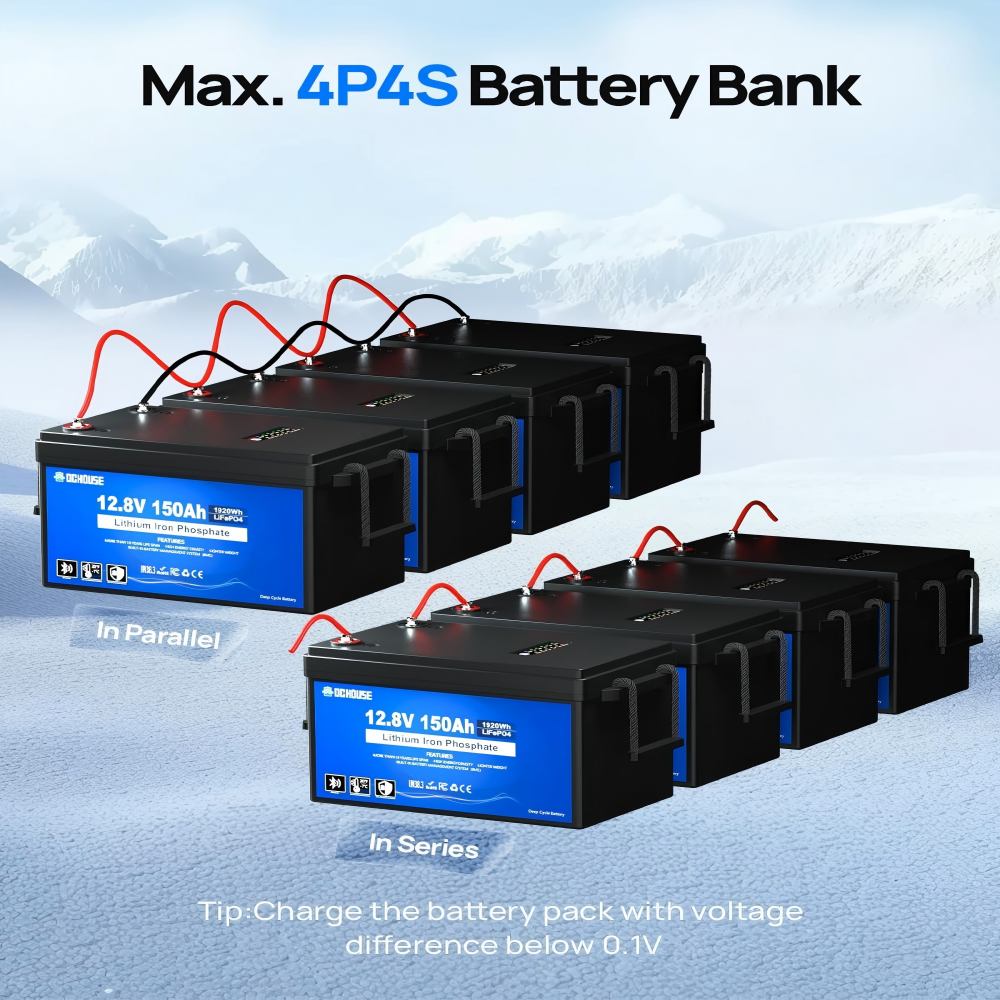
| Series and parallel | up to 4 batteries |
| Cycle life | up to 15,000 deep cycles, about 10 years of service |
| Energy density | 57 Wh per pound |
| Weight | about one third of a comparable lead-acid battery |
Ordering & Delivery
- Tell us what the battery will run — a caravan, a boat, a deep cycle trolling motor battery setup or a workshop circuit — and we will confirm the charger and cabling match.
- Measure the tray before you commit. Send us the space and a photo of your terminals; if this 12V deep cycle battery is replacing a deep cycle RV battery of the same class, the swap is usually simple, but heights and lug positions do vary.
- Stock orders are processed in 3–7 days. Custom builds take around 35 days.
- Shipping is swift delivery from local stock, usually 3–7 days in transit. We hold inventory in the USA, Europe and UK warehouses, so most orders ship from the region they are going to.
- Every battery is covered by a 5-year warranty.
- If the project is a 36V or 48V golf cart rather than a 12V system, we build those packs too and will point you to the right one.
- For a system plan or a resale listing, ask us for the full parameter sheet and we will send it across.
About Our Company
Xinyubattery is the brand of Shenzhenshi Xinyu Newenergy Technology Co.,LTD, a Shenzhen-based company founded in 2016 and working in green power solutions for more than ten years. Through a vetted network of production partners, we bring a broad range of power products together in one place and consolidate each order for you. Products are checked before dispatch, packed for export and shipped from local stock, and our team stays available for technical advice, fitting questions and after-sales help.
FAQ
Will it fit where my old battery came out?
Measure the tray, the height to the lid and the clearance at each end for the rope handles before you order — those three numbers decide most installations. The terminals are top-mounted and threaded, so cable lugs sit above the lid line rather than beside the case. Replacing a deep cycle RV battery of the same class is usually straightforward, but a 12 volt deep cycle battery from another brand can differ in height even when the footprint looks identical. Send us your measurements and we will tell you whether it drops straight in.
Can I charge it with the lead-acid charger I already own?
No. A 12V LiFePO4 battery needs a charger with a lithium profile; a flooded or AGM charger can leave it short of full or hold it at a voltage the BMS will not accept. The battery comes with a matched charger, so it can go straight into service. If you want a second deep cycle battery charger for a workshop or a second installation, tell us the setup and we will match the current to it.
Can I charge it from solar panels?
Yes, with an MPPT controller set to a lithium profile. A lithium deep cycle battery takes the controller's absorption stage without the long topping-up a lead-acid bank needs, and the BMS still guards against over-voltage if the controller drifts. On a boat it is a common arrangement — a marine deep cycle battery charged from a panel on the cabin roof through the week, then used for lights, a radio and electronics at the weekend.
How long will it run my trolling motor?
Runtime depends on the current your motor pulls, the speed setting and the conditions, so there is no single figure we can promise. What we can say is that as a deep cycle trolling motor battery, 150Ah gives a larger reserve than the 100Ah units many anglers start with, and the capacity stays usable as the voltage drops. For a day of stop-start fishing at moderate speeds this is a sensible size; if you run at full power for hours, plan on a larger bank or a second battery.
Can I leave it in the boat or caravan over winter?
You can leave it installed: charge it first, then disconnect the negative lead so nothing trickles it flat while you are away, and check it every couple of months. If the battery lives somewhere unheated, bring it above freezing before you connect a deep cycle battery charger — a marine deep cycle battery left aboard through a cold snap will simply refuse charge until it warms up. Give it a full charge again before the season starts.