Product Overview
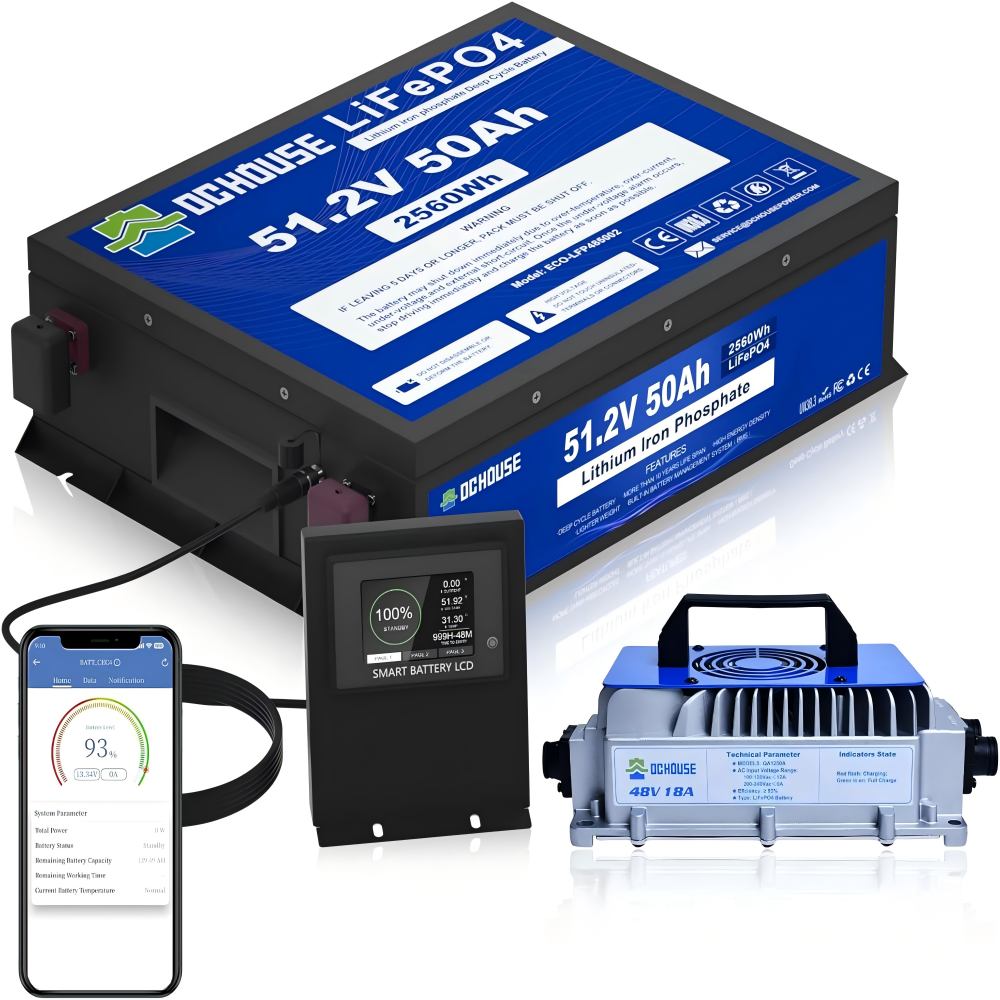
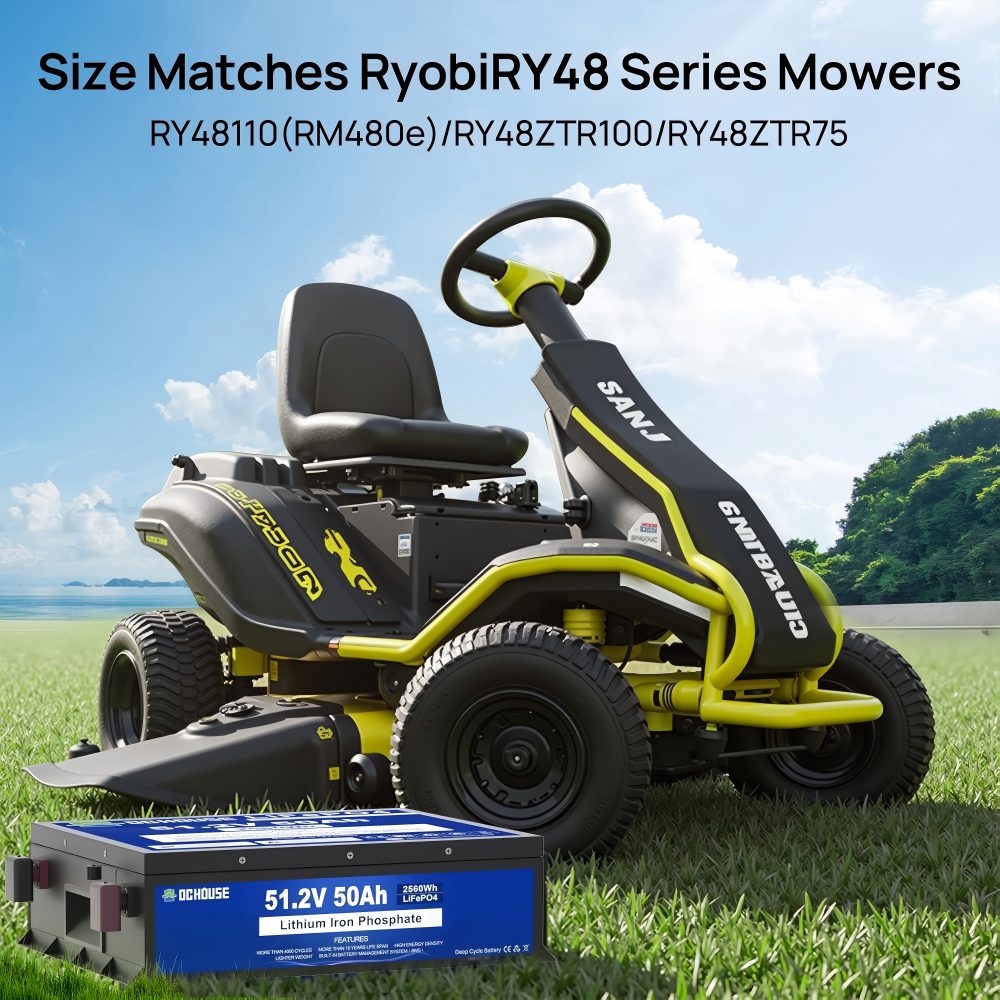
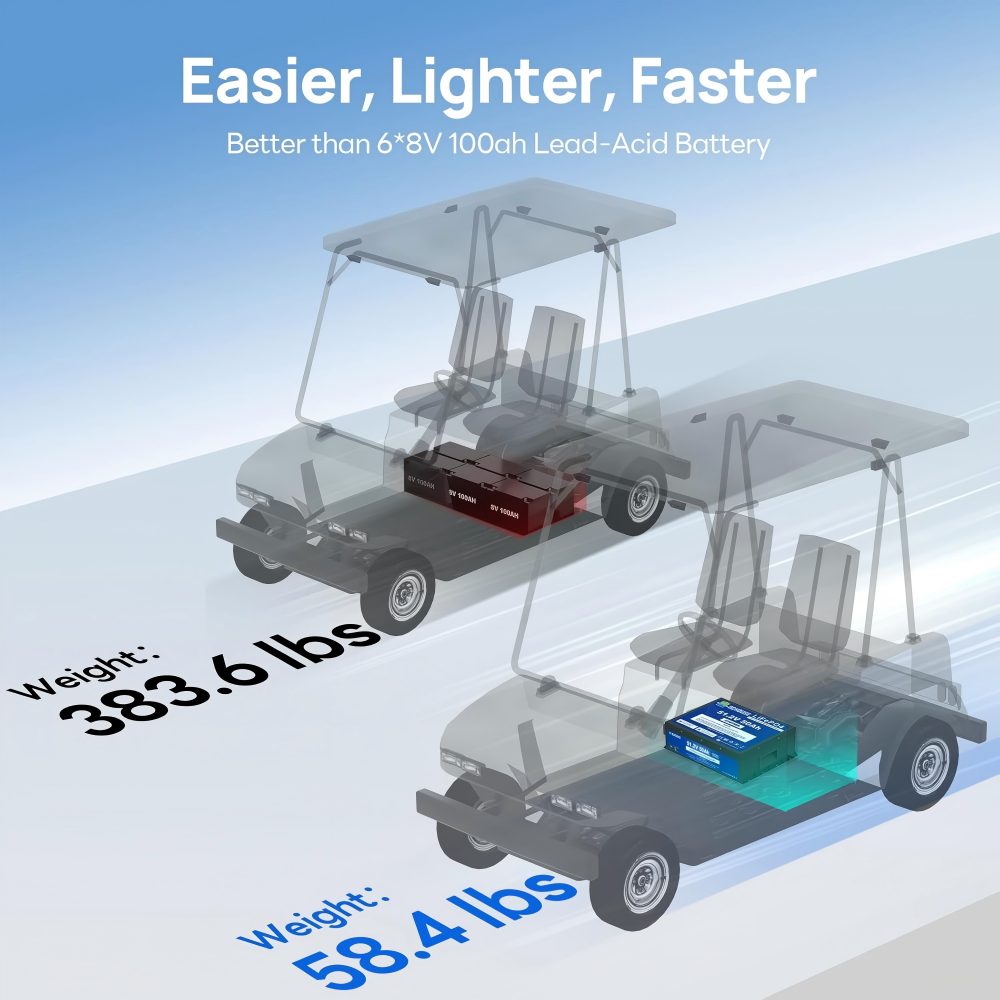
The kit is one compact 48V 50Ah lithium pack with everything needed to run it: the battery itself, a matched charger, a touch LCD monitor and Bluetooth access from a phone. It is built for the smaller end of the market: compact golf carts, garden and utility carts, and 48V mowers such as the Ryobi range. Most owners come to it from a tired lead-acid bank, and the change they notice first is handling — one light unit instead of several heavy blocks, no water to top up and no terminals to scrub at the start of every season. Because it is a 48V lithium golf cart battery rather than a like-for-like lead-acid swap, the install is a one-time rewire. After that the routine is short: plug in the charger, watch the red light flash, unplug once it holds green, and glance at the screen before a long run. Anglers and boat owners use the same pack as a deep cycle trolling motor battery for a morning on the water without hauling a lead bank to the launch ramp, and the sealed case takes the damp that comes with a boat parked outdoors. - Golf carts: 48V carts from Yamaha, Club Car and EZ GO, especially compact models and short-run carts. This 48V lithium golf cart battery drops into the space the old bank occupied and keeps the wiring to one pack. - 48V mowers: Ryobi mowers and zero-turn mowers running a 48V system, where the sheet metal case and steady current suit a deck that works hard and throws debris. - Trolling motors and marine craft: a deep cycle trolling motor battery for electric-motor fishing boats, living under a console or in a locker. - RVs, campers and off-grid setups: a compact case that fits lockers and cabinets a full-size 48V pack would not, for house loads that are modest rather than whole-vehicle. - Conversions and upgrades: as a lithium golf cart batteries 48V conversion kit, one order covers battery, charger and monitor, so nothing extra has to be sourced before the cart runs again.
Metal Case & Cell Build
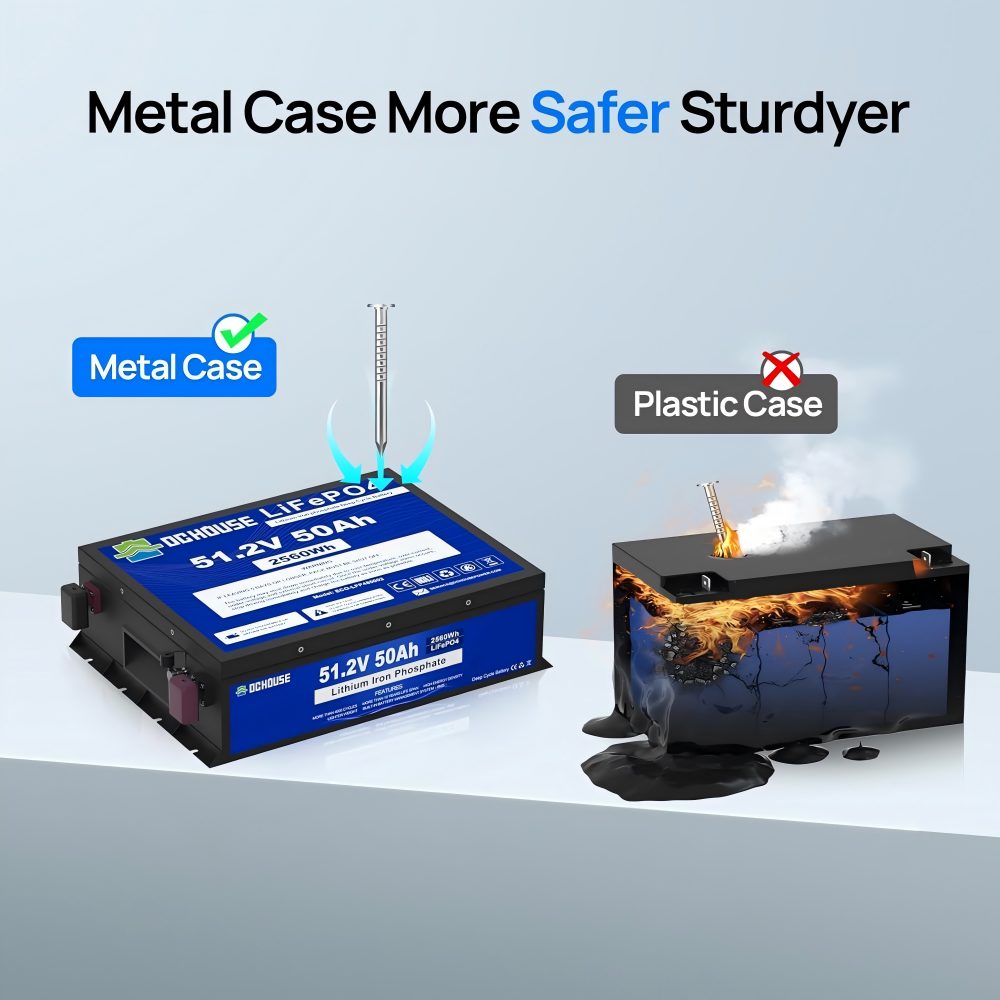
- Sheet metal rather than ABS: ordinary 48V packs in this class are usually built with a plastic shell. This one uses a sheet casing that is fireproof and resists impact, which matters most on a mower deck where stones and clippings come up at the box.
- Cells held by metal fixtures: the internal cells are fixed by metal fixtures weighing about 2.2 lb (1 kg) in total. Where other packs strap or glue cells in place, these fixtures hold each cell steady against the constant vibration of a cart or mower.
- A-grade cells inside: matched with those fixtures, the A-grade cells are quoted to extend service life by around 30%. A deep cycle lithium battery is bought for years, not weeks, so that margin is worth more than a small saving at checkout.
- Protection handled inside the pack: the BMS watches charge and discharge and steps in on over-current, over-charge, over-discharge and short circuit, so a mistake at the terminals does not become a damaged battery.
- Front terminals and a carrying handle: cables land at the front of the case and the handle lets one person lift the pack in or out. On a mini pack that is what makes a mid-season swap practical instead of a two-person job.
Capacity & Compartment Fit
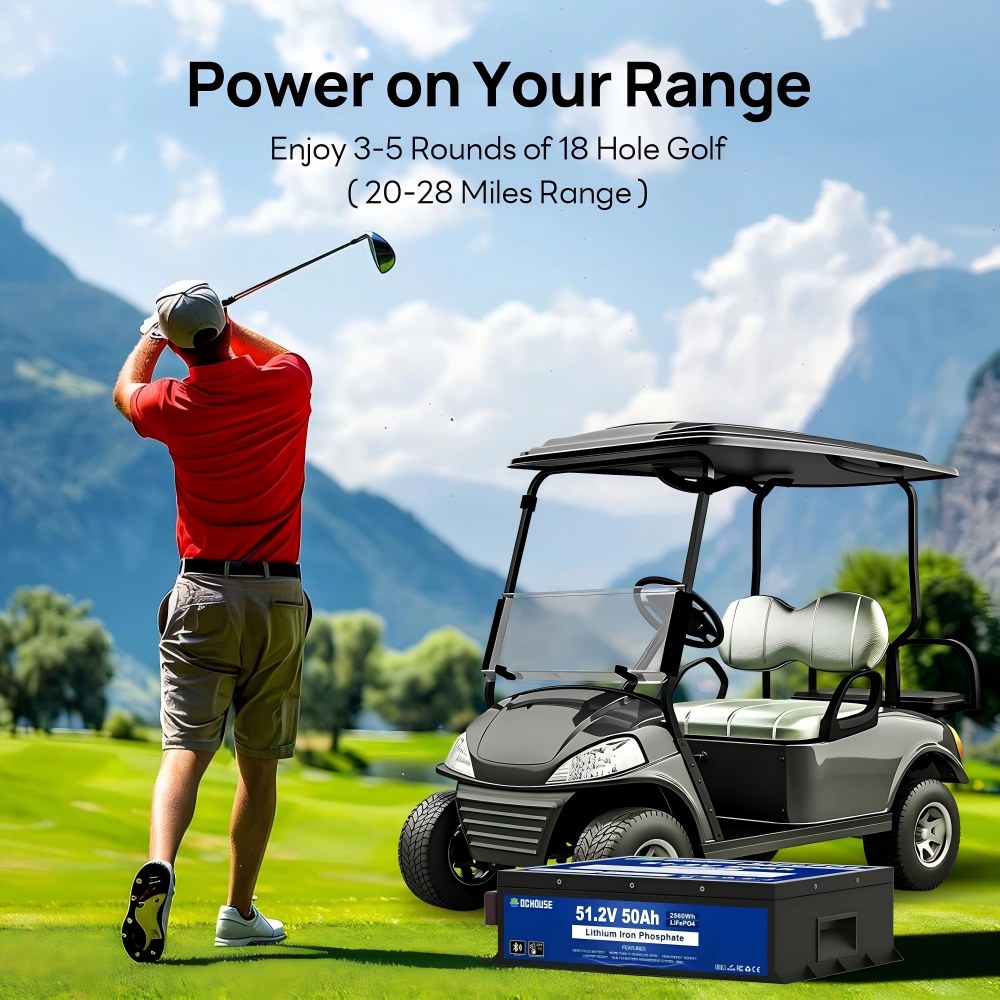
Fifty amp-hours is a deliberate size, not a compromise. A 100Ah pack suits long resort loops and all-day commercial duty; this 50Ah unit is sized for short courses, yard carts, garden mowers and second carts where the day's run is measured in a few miles. It also suits the buyer who uses a cart in bursts — a few holes, a trailer shuffle, a lap around the property — and recharges in between.
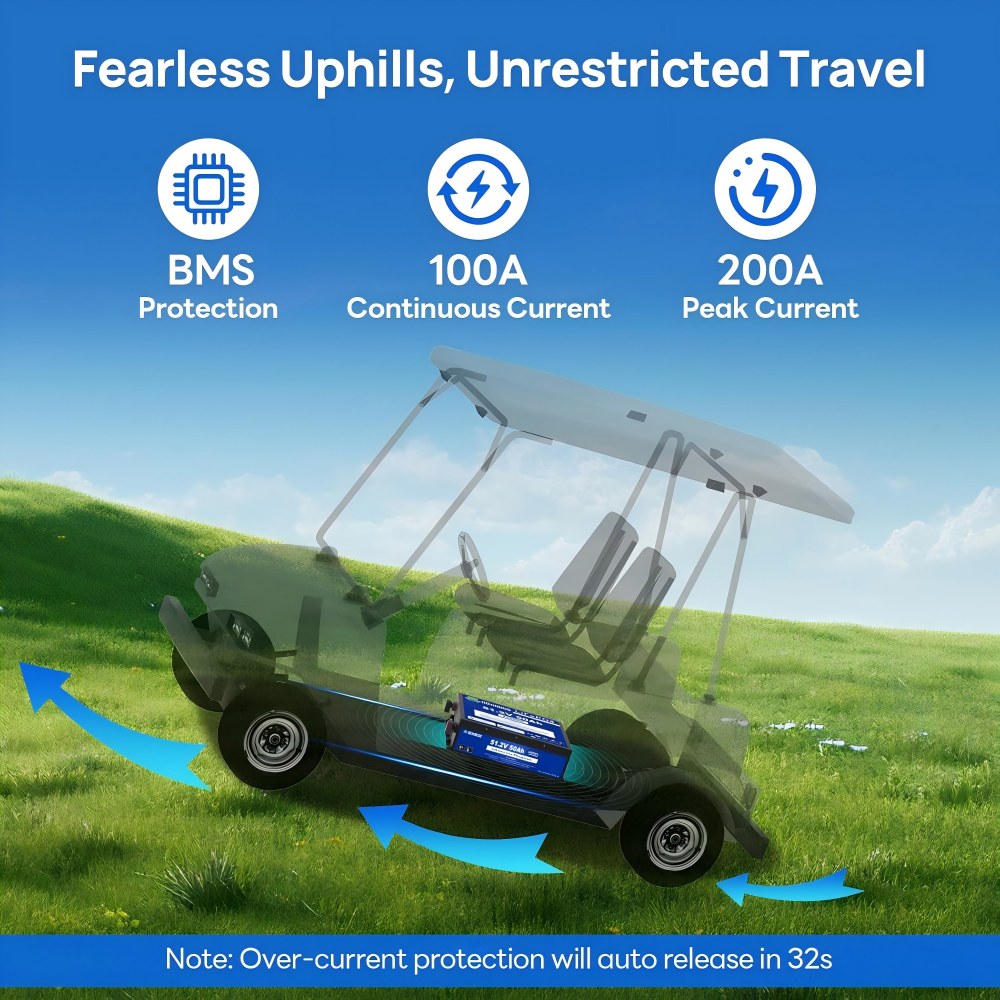
What a 48V lithium golf cart battery has to deliver is current, not only capacity. This pack supplies 100A continuously and up to 200A for about 10 seconds. Check the peak current your controller or mower asks for before ordering: anything above 200A puts this pack outside its range, and a higher-output model is the right buy. That 10-second window exists for the moment a cart pulls away on a slope or a mower bites into tall grass.
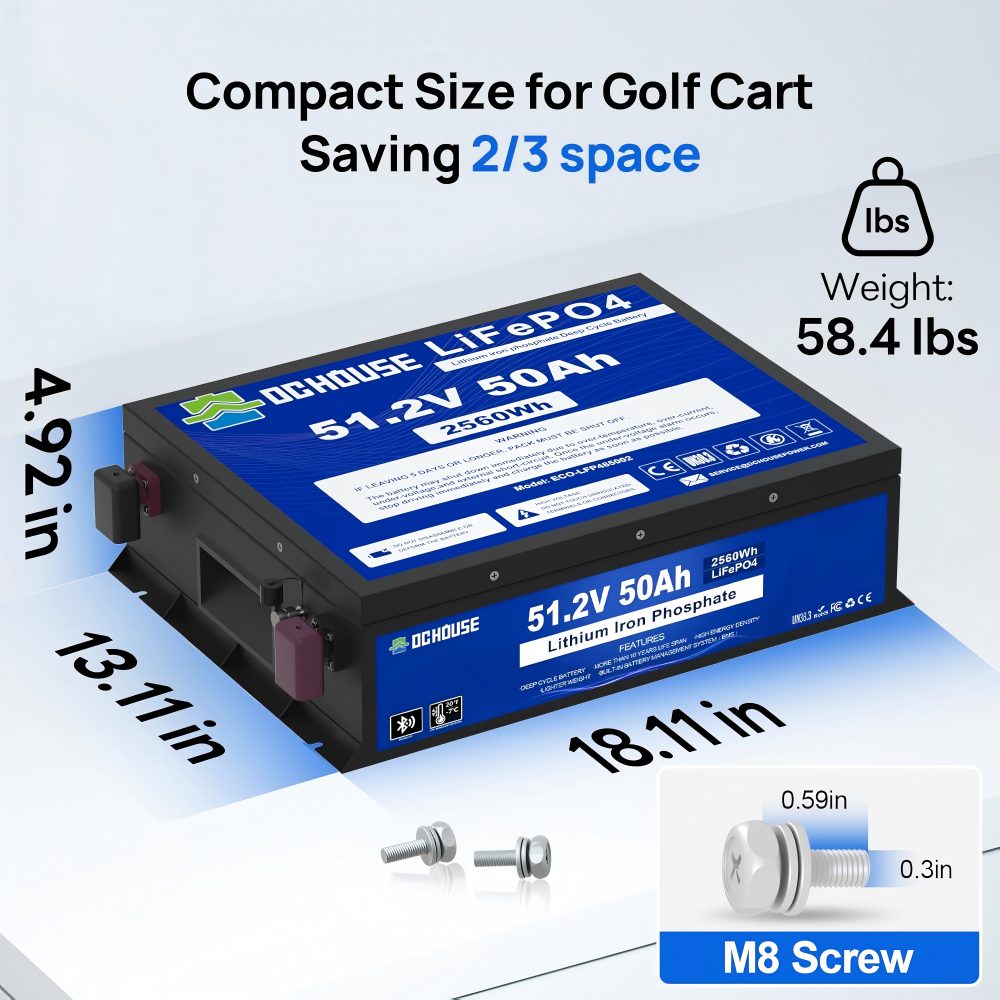
Then the bay. This is a mini format and noticeably smaller than a 48V 100Ah case, but battery compartments differ between Yamaha, Club Car and EZ GO models, and mower trays vary just as much. Measure length, width and height and leave room for the cable run and the monitor lead. If this is your first lithium golf cart batteries 48V conversion kit, work in this order — confirm voltage, confirm peak draw, confirm bay size — and the rest of the changeover is straightforward.
Specifications
| Rated voltage | 51.2V (48V class) |
| Rated capacity | 50Ah |
| Stored energy | 2,560Wh |
| Chemistry | LiFePO4 (lithium iron phosphate) |
| Continuous discharge | 100A (2C) |
| Peak discharge | 200A for 10 seconds |
| Battery management | 100A BMS with low-temperature protection |
| Included charger | 18A; AC input 90–260V; DC output 43.2–58.4V |
| Low-temperature cut-off | Charging stops below 20°F; discharge stops below 4°F; automatic recovery at 32°F |
| Monitoring | Touch LCD with three display modes, plus Bluetooth phone app |
| Parallel expansion | Up to 4 packs in parallel, 200Ah total; series connection not permitted |
| Cycle life | 8000+ deep cycles |
| Case | Sheet metal case with metal cell fixtures |
| Terminals | Front-facing terminals and a built-in carrying handle |
Cold-Weather Charging
Cold is the one condition that changes how the pack should be treated. Lithium golf cart batteries lose usable capacity as the temperature drops, so a cart that completes its usual loop in July may come up short in January. Plan shorter runs in freezing weather and keep the cart under cover where you can.
The pack also protects itself. A temperature sensor watches the cells: below 20°F the BMS stops charging, and below 4°F it stops discharge as well. Nothing is damaged by this — it is the pack declining to work outside its window.
Recovery is automatic. Once the pack warms to 32°F it returns to normal charging and discharging on its own, with no reset and no app command. In practice that means moving the cart into a warmer space or waiting for the day to warm, rather than forcing a charge.
Charging a deep cycle lithium battery below freezing is what shortens cell life, and this pack simply will not allow it. Bring it above 32°F, connect the charger, and leave it until the green light holds steady instead of flashing — that steady green is the honest sign the pack is genuinely full.
Charger & Charging Routine
A dedicated golf cart battery charger is part of the kit, not an extra. It is an 18A unit built for this pack, with AC input from 90 to 260V and DC output between 43.2 and 58.4V, and it carries its own protection circuit alongside the battery's BMS. Over-charge is therefore caught at both ends rather than relying on the pack alone.
The indicator lights tell you what is happening. Red flashing means charging; green, steady and not flashing, means the pack is genuinely full. A green light that still flickers is the charger still working, so leave it connected a while longer.
Matching matters because a 48V LiFePO4 battery charges on a voltage curve of its own, not on the loose profile of an old lead-acid charger. Use the supplied unit and keep the original cart charger out of the loop. If the charger is ever mislaid, replace it with a lithium-specific 48V unit of the same output rather than a garage charger built for flooded cells.
In season, whether it powers a golf cart or serves as a deep cycle trolling motor battery, the simplest habit works well: charge after each use rather than waiting for the pack to run down, and unplug once the green light holds. Put the cart on charge the evening before a long round, not the morning of it, so the pack has time to balance.
Monitoring & Touch LCD
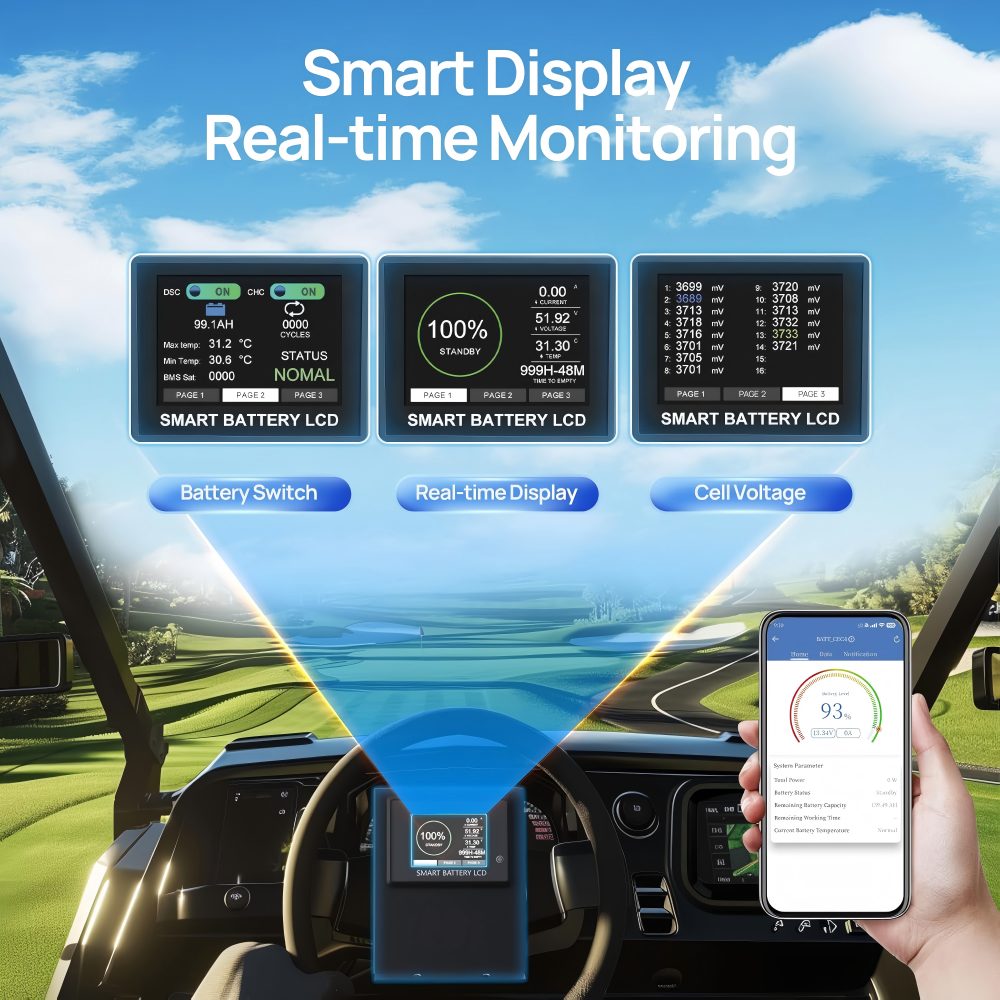
- Touch screen on the cart: the LCD reports real-time state of charge, voltage and current, so a glance before setting off tells you what the day allows.
- Three screen modes: Real-Time Display, Battery Switch Control and Battery Voltage. Switch to the voltage page when you want the raw number rather than a percentage.
- Output control from the screen: the switch control page turns the pack's output on or off without reaching under the seat, which is useful on a cart that sits between jobs.
- Bluetooth app on the phone: pair once and read percentage, voltage, current and remaining capacity, including from the house while the cart is parked outside.
- Daily life with a golf cart lithium battery is mostly about knowing the number. The screen covers the quick look at the cart; the app covers the deeper checks.
- Because this is a deep cycle lithium battery that gets worked rather than stored, the monitor is also the easiest way to spot a change in behaviour — a current draw that looks different from last week is worth investigating before a long trip.
Installation & Wiring
- Check the bay and the system before you start: this is a 48V pack, and the front terminals need to face your existing cable run.
- Photograph the old wiring, then disconnect the lead-acid pack and note which cable went to which terminal.
- Lift the new pack in by its handle and set it so both terminals are easy to reach; the mini case leaves more room than the old block.
- Connect positive and negative to the matching cables and check that both fixings are tight.
- Do not wire two packs in series — series connection is prohibited on this model. For more capacity, connect in parallel, up to four packs for 200Ah in total.
- Fit the touch monitor where you can read it from the seat and route its lead clear of moving parts.
- Charge to full with the included golf cart battery charger and confirm the green light holds steady.
- First run: watch the screen for current draw on your usual hills and note the percentage used, so later trips are easier to plan.
Storage & Off-Season Care
A pack that is going to sit should be put to bed properly. If the cart will be left for 30 days or longer, switch the battery off — the monitor's switch control makes that a one-screen job rather than a trip under the seat.
After the last run of the season, charge the pack within 24 hours of discharging it. Then top it up at least once every three months while it is stored, so the cells never drift down to a level they cannot recover from.
One warning is worth taking literally: in low temperatures the pack can be damaged if it is drained below 8V. Do not leave a cart parked with a flat battery in a cold shed over winter — charge it, switch it off, and check it again in spring.
Lithium golf cart batteries hold charge far better than flooded cells, but they are not immune to a long idle. Once a month, open the app and read the state of charge from the house; if it has slipped noticeably, put it on charge for a while.
Ordering & Delivery
- Lead time: in-stock orders are dispatched in 3–7 days; custom orders take about 35 days.
- Shipping: stock is held in our local warehouses, and delivery usually takes 3–7 days after dispatch.
- Warranty: every pack is covered by a 5-year warranty.
- Two parcels: because of the weight, the battery and the 18A charger ship in separate packages and may arrive on different days. A single parcel on the first day is not a missing item.
- Monitor in transit: if the LCD arrives damaged, send us a photo and we will arrange a replacement.
- Fit questions: send your cart or mower model before dispatch and we will check the pack against it.
About Our Company
Xinyubattery is the brand of Shenzhenshi Xinyu Newenergy Technology Co.,LTD, a Shenzhen-based company founded in 2016 and working in green power solutions for more than ten years. Through a vetted network of production partners, we bring a broad range of power products together in one place and consolidate each order for you. Products are checked before dispatch, packed for export and shipped from local stock, and our team stays available for technical advice, fitting questions and after-sales help.
FAQ
Will a 48V 50Ah battery be enough for my golf cart?
It depends on how far you run between charges. A 48V lithium golf cart battery at 50Ah carries 2,560Wh, which suits short courses, yard carts and carts used in bursts. If you cover a long resort loop or run the cart all day commercially, a 100Ah pack is the better fit. Also check the peak current your controller asks for — this pack allows up to 200A for about 10 seconds.
Will it fit where my lead-acid batteries sat?
Usually yes, because the mini case is smaller than a full-size 48V pack and the carrying handle makes it easy to set in place. Battery bays still differ between Yamaha, Club Car and EZ GO models and between mower trays, so measure length, width and height before ordering and leave space for the cables. A golf cart lithium battery that is too tight against the lid is a fit problem worth solving before delivery, not after.
Can I connect two packs in parallel for more range?
Yes. Up to four of these packs can be linked in parallel for a maximum of 200Ah, which is the intended way to grow capacity. Connecting lithium golf cart batteries in series is strictly prohibited on this model and can lead to battery failure. Keep every parallel link the same length and gauge so the packs share the load evenly.
What can I read on the touch monitor and in the app?
The screen has three modes: real-time state of charge, a battery switch control page and a battery voltage page. The Bluetooth app shows percentage, voltage, current and remaining capacity on a phone. Between them you can see what the pack is doing before a run, and a 48V LiFePO4 battery that reports its own condition is far easier to live with than one that only shows a warning light.
Do I need to buy a separate golf cart battery charger?
No — an 18A charger is included and is matched to the pack, with its own protection working alongside the BMS. Red flashing means charging, and a steady green light means full. Keep your old lead-acid charger out of the loop; a charger built for flooded cells does not follow the lithium charge curve and should not be used on this battery.
Will it run a Ryobi mower or a trolling motor?
It is designed for 48V applications that include Ryobi mowers, golf carts, trolling motors, RVs and off-grid systems. As a deep cycle trolling motor battery it suits an electric motor drawing within the pack's limits, and the sealed case copes with damp storage. For mowers and carts alike, treat it as a lithium golf cart batteries 48V conversion kit: battery, charger and monitor arrive together. Confirm your equipment's peak draw stays under 200A before ordering.
How long will the pack last?
The cells are rated for 8000+ deep cycles, and the metal fixtures that hold them in place are quoted to extend service life by around 30% when paired with A-grade cells. Real-world life still depends on how the pack is treated: charge after use rather than running it flat, keep it above freezing when charging, and top it up during long idle periods.